
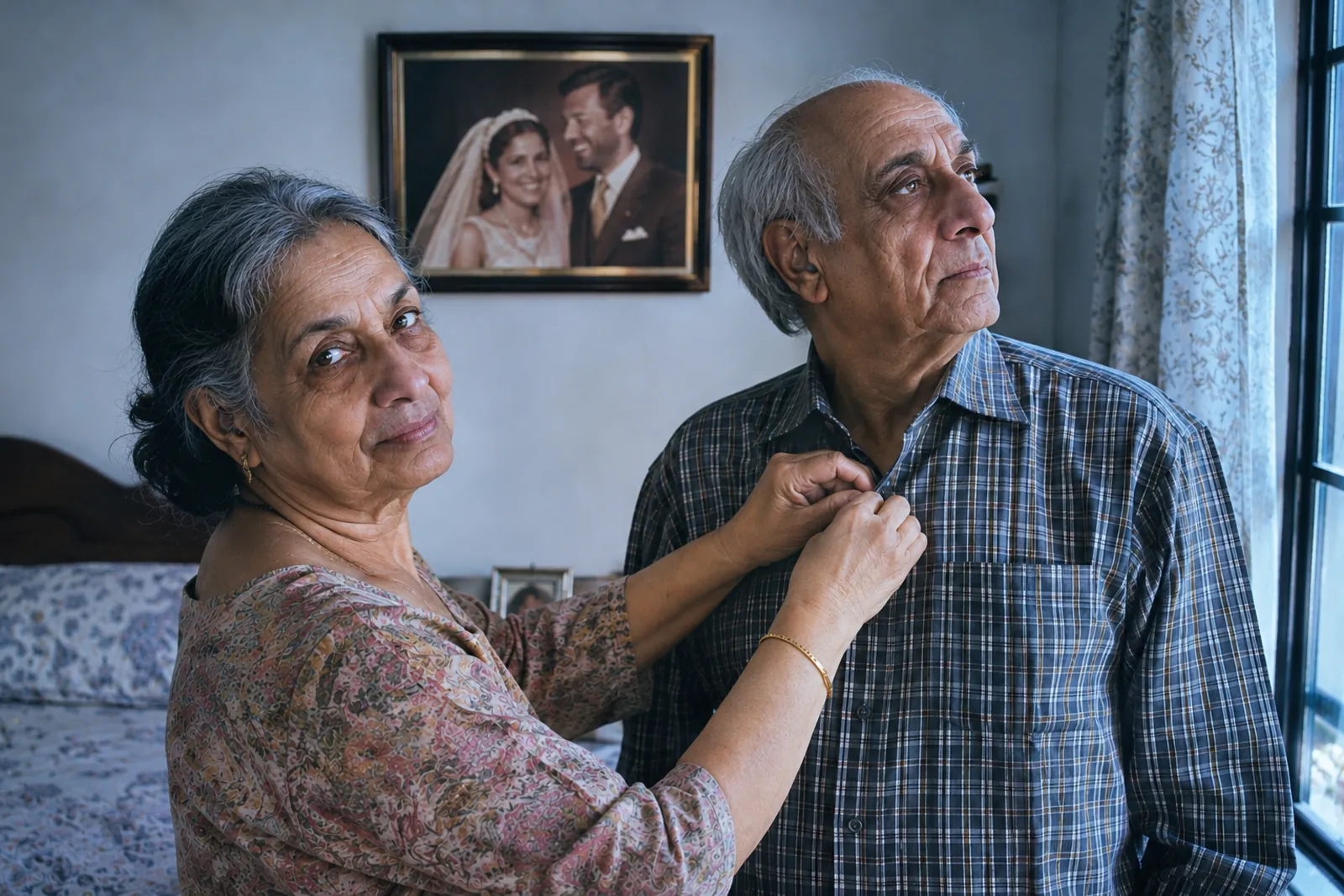
Dear Ray,
You won't read this. You haven't read a whole page of anything in about a year, not since the newspaper started to frustrate you and you said, very politely, that they must have hired worse writers. I laughed. You didn't. That was one of the first times I knew.
So this letter is really for me. The counselor at the senior center said I should write down the things I can't say to you anymore. Here they are.
I miss you. That sounds strange, because you are in the next room right now, watching the same cowboy movie for the third time this week. You're right there. You still hum when you eat. You still reach for my hand in the car. And I miss you so much some evenings that I have to go stand in the garage.
I read somewhere that there's a name for this, missing someone who is still here. Ambiguous loss. It helped to know it had a name. It didn't help with the garage.
For forty-six years you did the taxes and I did the birthdays. You knew where the water shut-off was. You called the man about the gutters. Now I do all of it, and I'm learning that I'm good at some of it and terrible at the rest. Last month I sat at your desk for two hours trying to find the homeowner's insurance policy. You would have found it in a minute. I found it in a folder labeled "Misc. Important." I said "oh, Ray" out loud, and you called from the den, "What did I do?" and I didn't have the heart to explain.
The hardest part is that I've become someone you have to be careful around. I'm the one who says no to the car keys now. I'm the one who reminds you about the shower. You look at me sometimes like I'm a strict nurse who's moved into your house. I want to say, it's me, it's Joanie, we went to Lake Tahoe on our honeymoon and you lost your wallet on the first day. Sometimes I do say it. Sometimes you smile like you remember. I don't ask whether you do.
Our friends have thinned out. Not all of them. Bill still comes on Thursdays and talks baseball with you, and you two laugh at the same jokes you've told since 1983, and I could kiss him for it. But the couples dinners stopped. I understand. People don't know what to say. I didn't either, when it was other people.
I'm keeping some things, Ray. Coffee on the porch every morning, even in November, with your blue mug. You don't always know what day it is, but you know the porch, and you know the mug, and for that half hour we are just us. I've decided to protect that half hour like it's the last good thing in the world. Some days it is.
I'm also learning to take help, which you'd find funny, since I used to complain you never asked for directions. Our daughter does the pharmacy on Saturdays. A young woman from the adult day program picks you up twice a week, and on those days I go to the library and sit in the quiet section and don't do anything. I used to feel guilty about that. I'm trying not to.
I promised for better or worse. I meant it. I just didn't know that "worse" would look so ordinary. A Tuesday. A lost wallet that's really a lost word. A man I love asking me, very kindly, if I've seen his wife.
I have, Ray. She's right here. She's tired, and she still loves you, and she'll be on the porch tomorrow at eight.
Yours, as ever,
J.
If you're caring for your partner
A few things that helped this caregiver, in her own words: keep one daily ritual that belongs only to the two of you. Let friends help in small, specific ways, even if it's just one afternoon a week. And find somewhere to say the things you can't say at home, whether that's a counselor, a support group or a notebook.
Questions people ask
Why is caring for a spouse with dementia so hard?
Many spouse caregivers describe grieving the partner they knew while still caring for them every day, and taking on all the roles the couple used to share. Some find comfort in knowing this feeling has a name, ambiguous loss.
How can I keep my marriage close while caring for my spouse with dementia?
This caregiver protected one small daily ritual that was just theirs, morning coffee on the porch, and accepted help elsewhere so that time stayed calm.
Keep reading
This story is told in the voice of a family caregiver. Names and details are illustrative, drawn from what many caregivers describe.
If you are caring for someone and it feels like too much, you can call or text 988 in the US at any time. The Caregiver Action Network helpline is 1-855-227-3640.